
Apple’s posted this graphic (h/t Robert Davey) in a public page of its developer portal:
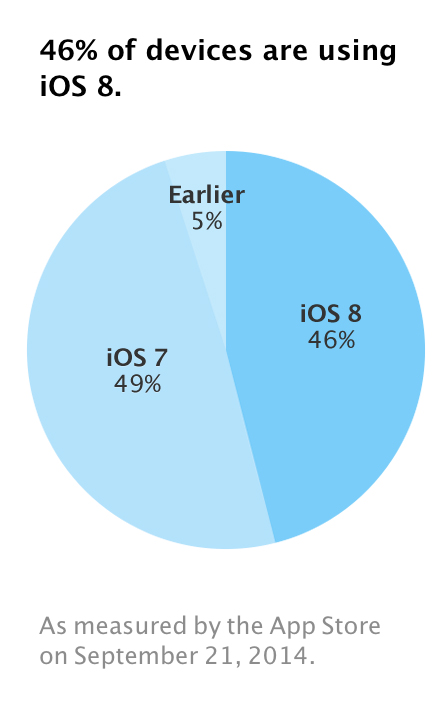
iOS 8 was released on September 17th and the chart was last updated on Sunday, Sept 21st, so the data represents the first 4 days of release.
This compares favorably with ad network Chitika’s report of tepid iOS 8 adoption posted within a day of the release, showing a 24 hour adoption number of 7.3% for iOS 8 as opposed to 18.2% for the first 24 hours of iOS 7.
Since getting apps in the app store becomes harder and harder as your OS ages (try downloading some apps with iOS 6 and see how many times you try to download an app, only to be told that it doesn’t run on your device), counting adoption by measuring App Store access seems at best questionable. I bet this is pretty far off actual usage numbers.
In fairness, this is from a report to developers. It is relevant to the audience, but no, it should not be taken as a measure of overall adoption. Same is true of Google Play reports of Android version deployment. No one seems able to properly report on this.
Could you elaborate why counting adoption by measuring App Store access “seems at best questionable”? What would be a good way to measure adoption?
“This compares favorably with ad network Chitika’s report of tepid iOS 8 adoption posted within a day of the release, showing a 24 hour adoption number of 7.3% for iOS 8 as opposed to 18.2% for the first 24 hours of iOS 7.”
Didn’t iOS 7 come out day and date with the iPhone 5s?
iOS 7 was released on the 18 Sep ’13, the iPhone 5s was 2 days later on 20 Sep ’13. This seems to be the way Apple like to do it.
I’d say it’s a perfectly reasonable way to measure it, if not the best way. Measuring unique device activations wouldn’t account for devices that go out of service. By measuring app store access you get a realistic view of the current state of all devices over a recent period. As the app store automatically checks for app updates in the background (and can even update them automatically from iOS 7 onwards) devices that are on and in use will be regularly getting counted in the distribution meaning it’s probably pretty accurate whether users on iOS 6 can download a lot of apps these days or not.
Come on 80%. Going iOS 8 only when it does.