
Smithsonian Air and Space:
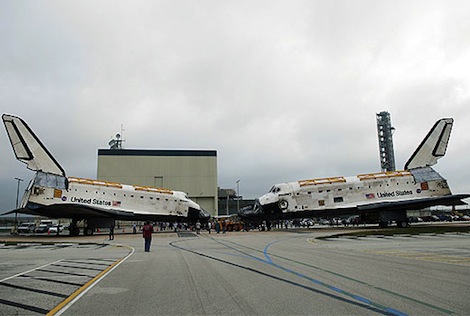
After flying 148 million miles and orbiting Earth 5,830 times, Discovery, first flown in August 1984, was being decommissioned and readied for its trip to the National Air and Space Museum’s Steven F. Udvar-Hazy Center in northern Virginia, where it will arrive in mid-April.
The three main engines had been removed from the shuttle’s aft end, which was now covered by a tightly fitted mask with three white discs the size of the engine bells. Clear plastic stretched across the crater in the orbiter’s nose, where the forward reaction control system—small thrusters that maneuvered the spacecraft in orbit—had been removed.
And this harvesting of the orbiter’s components was only the beginning.
I always wish I had seen one of these launches in person.
Me too, Shawn. I used to have a poster of a space shuttle on my wall as a kid.
I wish we’d seen a launch, too. When we lived in South Florida, they’d always come to land from the South, flew RIGHT over our house. The sonic boom rattled the windows and scared the dog….. =)
How could you have lived in south FL and and not gone to see a launch!?
The real problem is the shuttle fulfilled it;s original design. A truck to build the giant space station. The real tragedy is NASA thought about a replacement for the shuttle to late.
I hope Elon Musk’s space-oriented projects prove commercially successful, which will in part keep space technology progressing.
I lived in south Florida for nine years and only ever saw launches from hundreds of miles away, which mostly meant that on clear nights we could make out a light and on clear days we might see what looked like a contrail in the distance. As kids we had field trips to visit the various sites, but we never saw anything more than any other visitor.
Ironically, it wasn’t until I moved to the Houston area and we became family friends through church with an astronaut’s family that I actually got to see a launch from up close. Our friend was on the mission, so we were invited to attend the launch for STS-109 and ended up sitting in the VIP/family section (the Banana Creek site, a little under 4 miles from the pad). I have to say, it was unlike anything else I have ever seen. It’s one of the few times in my life where I can honestly say that the pictures and videos simply do not do it justice. It only took a moment for me to realize how woefully I had failed to comprehend the magnitude of it all. I had never realized how many filters must be on the lenses taking pictures, since the flame from the engine was on par with the brightness of the sun. And the sound! Incredible. Everything just shook and shook.
I got a good laugh afterwards too, since it was a beautiful sunrise launch through a hole in the clouds, and the plume left by the engine was turning all sorts of gorgeous colors of purple, orange, and green in the light of the rising sun. We were all admiring it, when some officials came over and informed us that we needed to board the busses and vacate immediately since that plume was made of highly toxic chemicals and the wind was blowing it our direction.
Also, we didn’t know it at the time, but that was the start of Columbia’s last successful mission. Its next launch was for STS-107, which ended in tragedy on reentry. Even more scary was that, as the flight numbers indicate, STS-107 was originally scheduled to fly first, but because of various delays, they decided to swap the two launches and send up our friend’s mission first.
Great story. I saw the last launch from Titusville and you have not overstated a single point.