
I have had my share of rants about how RIM has handled its PlayBook introduction and the fact that they can’t seem to ship anything, but the non-existent tablet isn’t the only problem the company has.
[ad#Google Adsense 300×250 in story]The smartphone market was RIM’s to lose. They controlled the market with its BlackBerry device, but the company seems to have fallen into the same trap as the Palm Pilot before — they stopped innovating.
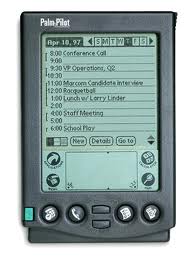
Before the BlackBerry became huge, Palm controlled the market with the Palm Pilot. Everyone had a Palm — it was the cool thing to have, but the company stopped innovating and they lost the market.
RIM is in the same boat with its BlackBerry. The only thing that broke them out of the box of being an enterprise email client is the huge success of the iPhone.
“RIM didn’t expect iphone to take off the way it did because it was so badly flawed from day one,” a former RIM employee said in a recent report. “They believed that users wanted great battery life, great security, great mail handling, minimal network use, and a great keyboard experience. They never expected users didn’t care.”
 RIM products released since the iPhone are remarkably similar in form and function. RIM would have you believe that this is all part of the plan, but a company that is on top of its game doesn’t wait for the competition to come along and change things. If they know what they’re doing, they’ll do it themselves.
Even HP accused RIM of copying its WebOS. RIM didn’t deny the accusation, only saying “Well, when you’re trying to optimize user experience that juggles multitasking, multiple apps open at once and on a small screen, you’re going to get people landing on similar kinds of designs.”
RIM is hurting right now. It’s having trouble competing with the iPhone and its over a year behind on its tablet strategy.
This is how companies become irrelevant in an industry they once ruled.
This seems like the wrong article to have a blackberry ad underneath…
Yeah RIM is hurting and is becoming irrelevant. The writing is on the wall. Let’s take a look:
1. They have year over year growth – globally, not just in the US. (which is no minor feat).
2. They still have a commanding marketshare in enterprise.
3. People are still buying them – in fact more are grabbing a Berry than they were before despite what some circles state- just look at the global numbers.
4. They’ve got QNX coming as an update to their older OS which they’ve acknowledged needs to change.
5. They’ve slated massive upgrades to their hardware to take advantage of the new OS.
6. They are entering the tablet market within 2 weeks. The PlayBook has already received countless reviews, and every concern has been shot down. Multiple development, catering to both business and consumer, competitively priced, and secure.
So they are churning out new products from their existing lines, improving what they have both in terms of OS and Hardware, moving into new entirely new product lines, and continuing their expansion globally.
Where is the irrelevance exactly?
Jim Dalrymple, you sure a great journalist. It’s good to know that you, like most journalists these days, jump on pop culture bandwagons. Thank you for this informative article. I haven’t heard anything like this in the media before.
Go ahead, talk about how android and iOS are the greatest inventions on earth. The app store and touchscreens were all created by Apple. Corporations are throwing out their blackberries by the millions and Apple is surely stomping RIM in numbers.
Oh wait, that’s not true… RIM outsold Apple in the UK. Corporations are waiting for the Playbook. The android market is saturated with a bunch of phones that look exactly the same.
Give me a break.
Sorry, this article must be a joke.
1. Growth – like Nokia and they’re doing well aren’t they
2. Marketshare – um, like Nokia again
3. People still buying (kinda like 1. and 2., so see above)
4. Ooh future … I think they’ve spoken enough about the future of their products, and they remain still in the future. Good business model: “Our CashFlows are coming soon, so please stick with us”
5. More future … see 4.
6. In 2 weeks time they’ll still have shipped zero, compared to the 17m of other models of pads and slates.
Irrelevance in tech does not mean the same as disappeared. Sony not long stopped making the cassette playing Walkman.
The problem is, profit and relevancy are not necessarily in sync. First companies lose relevancy, later followed by profitability. RIMM still makes very functional and practical devices that are currently well entrenched in the enterprise market. That said, the writing is on the wall in terms of paying for BES servers, etc. They will be phased out over time.
Below are a few things to consider with regard to the points you’ve made.
1. Year over year growth is great, but the fact remains, RIMM’s growth rate is less than the industry’s growth rate. For this reason, RIMM is losing market share as compared to iOS and Android.
2. Yes, RIMM still has a commanding lead in the enterprise. The operative words here are “still has” as the trend is headed the other way. The enterprise market is slow to react to market realities. Once they lose that lead, it’s gone for good.
3. Yes, people are still buying RIMM products. People are still busying Windows Mobile products as well. Your point being??
4. Yes, QNX will be a big improvement. However, change also brings risk. Any positives gained by going with QNX is lost on embracing Adobe Air as a development platform. This will backfire and RIMM is not exactly making it easy for would be developers for the playbook, are they?
5. Their hardware will REQUIRE massive upgrades to accommodate their new OS (Adobe Air specifically).
6. The playbook was vaguely interesting when competing against the iPad 1. The market is being flooded with many pretenders to the throne these days. Apple is presenting RIMM with a window simply because they can’t manufacture enough iPad 2 devices right now. Worse, RIMM apparently knows they won’t be able to compete based on their own native apps, so they’re trying to become Android compatible??? Sorry, but that’s clearly an admission that they know they can’t compete.
Anyway, as others have stated, the market is big enough for multiple companies to be profitable. I expect RIMM will be no exception here. However, RIMM is no longer relevant because they are simply playing follow the leader and are not innovating or taking the market in any new direction. As such, profitable or not, Jim’s point still stands.
While corporations are waiting for the PlayBook, they keep themselves busy by buying iPads by the truckload.
Whose devices do you use?
Actually, it would have been funnier if it had included quotes from either of RIM’s co-CEOs.
The “irrelevance” is in same numbers. Yes, they’ve got year-over-year growth in units shipped, but the market is growing faster, so their share is declining. And the amount they receive for each Blackberry device is declining along with demand, but RIM knew the only way for it to stoke the demand fire was to reduce prices.
Also, though RIM is still much more profitable than all of the Android OEMs combined, it makes less than $1 profit for every $4 Apple makes, despite the fact that they (RIM) still move a ton of phones.
Perhaps the most obvious proof of RIM’s slide toward irrelevance is the fact that they recently stopped reporting their percentage of new customers on a quarterly basis, probably because they’ve seen this number fall from the high 60s a few years back down to the mid 30s. Put another way, it used to be that 2 of every 3 BlackBerry devices sold were sold to new customers, but now that number is 1 in 3 and falling. BlackBerry isn’t really growing anymore. . . it’s just replacing old devices with newer ones.
@axe – read this analysis, on “How a computing platform dies”
http://mobileopportunity.blogspot.com/2010/10/whats-really-wrong-with-blackberry-and.html
note the charts on dwindling
– New Subscribers Per Unit Sold
– Device Gross Margin
– Revenue Per BlackBerry Device Sold
and then the startling “OS Preferences of People Planning to Replace Their Smartphones”
analysis this and come back to us.
i’m buying a playbook. if i was an apple fan boy i would be more concerned with steve jobs health and not whether rim will die!
steve jobs is apple. if he dies apple dies!
Playbook … what play and what book…
It is irrelevant too because it must be tether to a blackberry.
Btw BES is killing RIM in the enterprise because no one wants to pay extra for it/.
Somebody’s been sipping the RIM CoolAid.
If you had properly read the article, you’d have seen that Jim was talking about how RIM has stopped innovating, not how other companies react to RIM’s actions.
Just to be clear: IMO there are two UIs that are more innovative than iOS or the base-Android OS: Palm’s WebOS and Mirosoft’s WinPhone 7 UI.
The former I’d like to see influence iOS to some degree, the latter isn’t for me, but I know lots of people that really enjoy using it.
Fair question Sir, fair question.
You’re an idiot, period. Go back to Jizzmodo.
Tehehehe, talk about platform lock-in, eh?
As much as it pains me to admit it, you’re right Jim.
I used to love my Palm devices and even programmed a bit for them, but when Palm didn’t manage to implement necessary features, or even tried to get on par with — wait for it — Windows CE —Oh the Horror! — I started to get frustrated.
RIM needs a similar realisation as Nokia had a few weeks ago, before they announced the deal with Microsoft. I have a feeling they can still turn the tide if they get their act together.
If that happens, where would RIM get their ideas?
ZING!
If RIM is the new Palm, perhaps the RIM Playbook is the new Palm Foleo?
For those of you who don’t remember, the Foleo was a notebook computer announced and publicly demoed by Palm, but it never shipped!
One other similarity: the Foleo needed to be paired with a Palm phone to send email.
More details here: http://en.wikipedia.org/wiki/Palm_Foleo
> They believed that users wanted great battery life, great security,
> great mail handling, minimal network use, and a great keyboard
> experience. They never expected users didn’t care.
None of those things trumps a PC class operating system, PC class native C apps, PC class Web browser, PC class email, PC class 3D graphics interface, innovative multitouch controls, iPod class audio video, and iPod class administration. Apple leap frogged RIM, plain and simple. Apple made the smartphone into a kind of PC instead of a kind of phone or pager.
> 1.
Having year over year growth in mobiles is not hard … the entire mobile market is growing. RIM has very modest growth compared to others. They have to not just grow, but grow faster than competitors, which they are not doing.
> 2.
Their corporate contracts are shrinking, not being renewed. Just as Android has replaced Windows Mobile devices, iPhone has replaced BlackBerry devices.
> 3.
That is just your point 1 again. Yeah, people still buy fewer BlackBerry as a share of the market than ever. Yeah, it is no longer the most-desired smartphone.
> 4.
> 5.
> 6.
All imaginary. No real actions here. None of these things have served one user or made one dollar. Even on paper, if PlayBook is more than $299 it does not compete with iPad 2, and we have heard $499 only, at which price it is DOA. Compared to iPad it has half the screen, is bulkier, has no native API, has no apps at all, is very immature and will be buggy, and depends on a BlackBerry only for core features. Prove me wrong, RIM.