Written by Peter Cohen
Technologizer:
I’m all in favor of developers drawing upon old games for inspiration, improving them and turning them into entirely new ideas. And I like fan-made homages when they expand significantly on the original and–this is important–are not sold for commercial gain (Vector Tanks cost $1, and Extreme cost $2). But in this case, the makers of Vector Tanks simply copied Battlezone’s look, feel and core play mechanics, and added a few frills. That’s a soulless approach to game design, and it’s best left to Atari.
Jared Newman defends Atari’s decision to go after Black Powder Media, an iOS developer which released a Battlezone-style tank combat game. He raises some good points, including the double-standard often applied to big game developers that engage in the same sort of action as indie developers. Read it for a different perspective on this debate.
January 3, 2012
As most of us were celebrating the holidays and getting ready for the new year, one music legend was fighting for his life. Unfortunately, Richard Lainhart didn’t win his battle. Below is a note posted by his wife. There are also plenty of links to his music and videos.
Richard Lainhart February 14, 1953 – December 30, 2011Dear friends of Richard, It is with a heavy heart that I that I must tell you Richard Lainhart, composer, musician, technologist, filmmaker, and digital artisan died Friday, December 30, 2011.On December 17, Richard complained of pains in his side and was admitted to the hospital for tests which showed an intestinal cancer. He was operated on on December 21. After the surgery (which showed the cancer had not spread), there were infectious complications which took his life on December 30.He struggled valiantly to overcome his infection, but it was not to be. We are all in shock and cannot grasp the idea of his not making music, talking music, teaching, posting and playing.Caroline Meyers Richard Lainhart’s wife
It seems that not every company on the list of SOPA supporters actually support the bill. Taylor Guitars on Tuesday provided me with some information that explained how they initially ended up on the list of supporters.
“In August 2011, Taylor Guitars, its trade organization, NAMM, and other music industry manufacturers offered a signature of support on a U.S. Chamber of Commerce letter sent to Congressional members to encourage the introduction of anti-piracy and counterfeiting legislation,” Taylor said in a statement provided to The Loop. “As the letter was not bill-specific, we felt the spirit of its intent was in accordance with our efforts to confront ongoing piracy and copyright infringement issues that we, like many others in the industry, continue to battle.”
That seems to be the common theme when talking to people about SOPA — people support anti-piracy legislation, but SOPA is out of control.
Taylor said that its signature of support and its “desire to stop piracy and counterfeiting has been misrepresented as support for the Stop Online Piracy Act (H.R. 3261).”
Having read that, I have to wonder how many other companies find themselves in the same position. How many support anti-piracy measures and wrongly found themselves on a list of SOPA supporters.
“Clearly stated, we do not support SOPA and its intent to restrict the Internet,” said Taylor. “The values of freedom, creativity and innovation are at the core of our business, and SOPA is not in accordance with those values.”
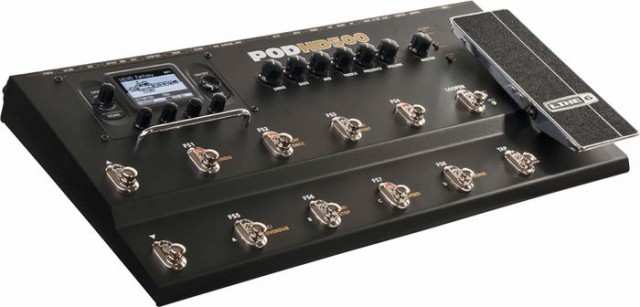
I’ve been using Line 6 gear for many years and have watched them grow into one of the best amp modeling companies in the business. The Pod HD500 stompbox is yet another success in the Line 6 arsenal.
The HD500 is a lot of things bundled in one box. It’s an audio interface to your computer; an amp modeler; effects modeler; and a stompbox that can connect to your amp or PA. Basically, it’s a unit that’s built to do it all.
I expect different things from an audio interface than I do from a stompbox. When I see a stompbox, I think of playing live and all of the perils that come with that.
The biggest problem for me is toughness. When I see some of these pretty looking stompboxes on the market, I immediately think, “that wouldn’t last a night under my foot.” I’m not saying I abuse my gear, but if it’s made for me to stomp on, that’s what I’m going to do. And the Pod HD500 takes it night after night, song after song.

I’ve been through the problems of pedals getting gummed up or not responding when you step on it. That’s not only frustrating, it pisses me off.
Of course, you don’t just have to worry about playing, but moving the stompbox to and from the venue. Let’s face it, you don’t baby the thing when you’re unloading, do you? No. It gets dropped, thrown, stepped on, spilled on, kicked and flung. It’s the nature of the business.
I’ve been playing for years and my old stompbox was a piece of plywood with the pedals fastened to it. I loved that thing. You could set a bomb off and it would come through unscathed. That’s what the HD500 is like for me.
Enough about toughness, how does it sound? That’s the other important factor, isn’t it? It’s fine to get your HD500 to a rehearsal or gig, but if it sounds like shit, it’s not going to last long.
I work hard on my presets, to get that perfect sound (and by perfect, I mean I keep fiddling with it because I’m rarely satisfied with any tone). Because of that, I usually like to plug the HD500 directly into the PA. That’s just a personal preference.
I’ve tried it running through my JCM 800 and it sounds great, but I like having all of those little nuances in the tone that I get from running the HD500 by itself.
As the name implies, this new stompbox comes with “HD” amp models. That basically means that Line 6 found a way to model the 22 amps in such a realistic way, they could only describe them as HD. But are they really that good? I had my doubts, but was quickly convinced after playing it for a short time.
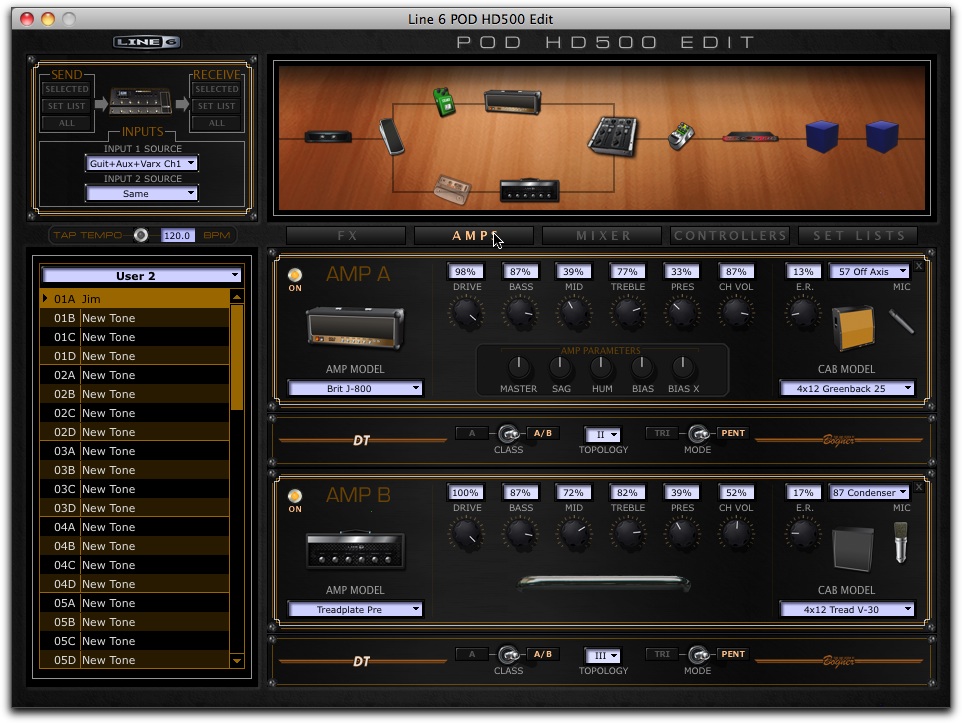
Amp modeling has come a long way in the past few years and you can hear a difference with the Line 6 HD amps. It was kind of strange to hear them at first — maybe them sounded a bit too real or something. Whatever it was, I liked it.
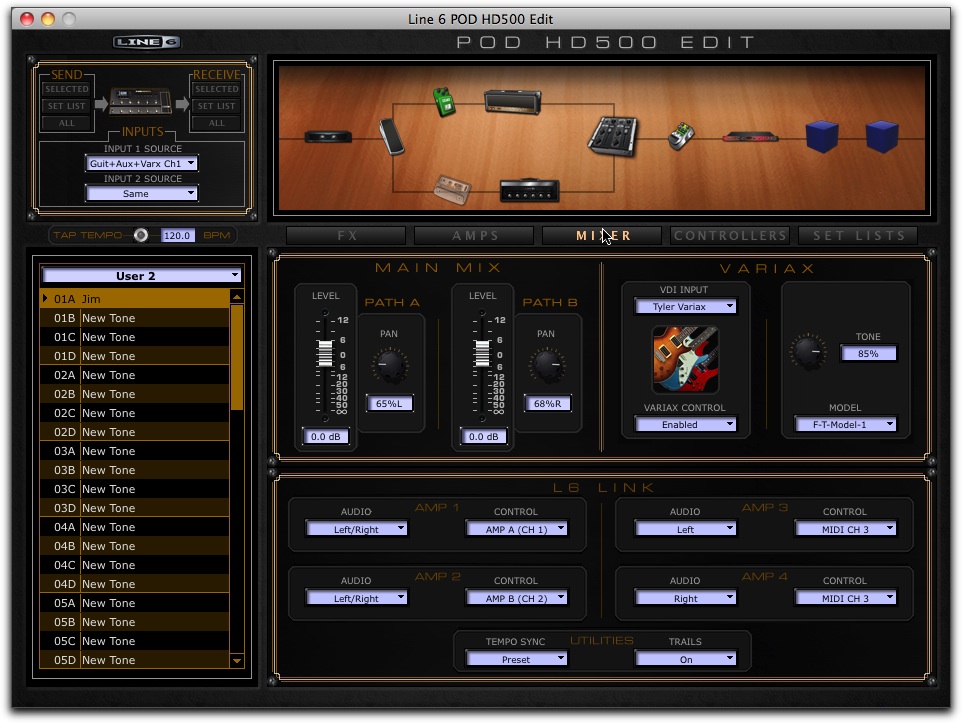
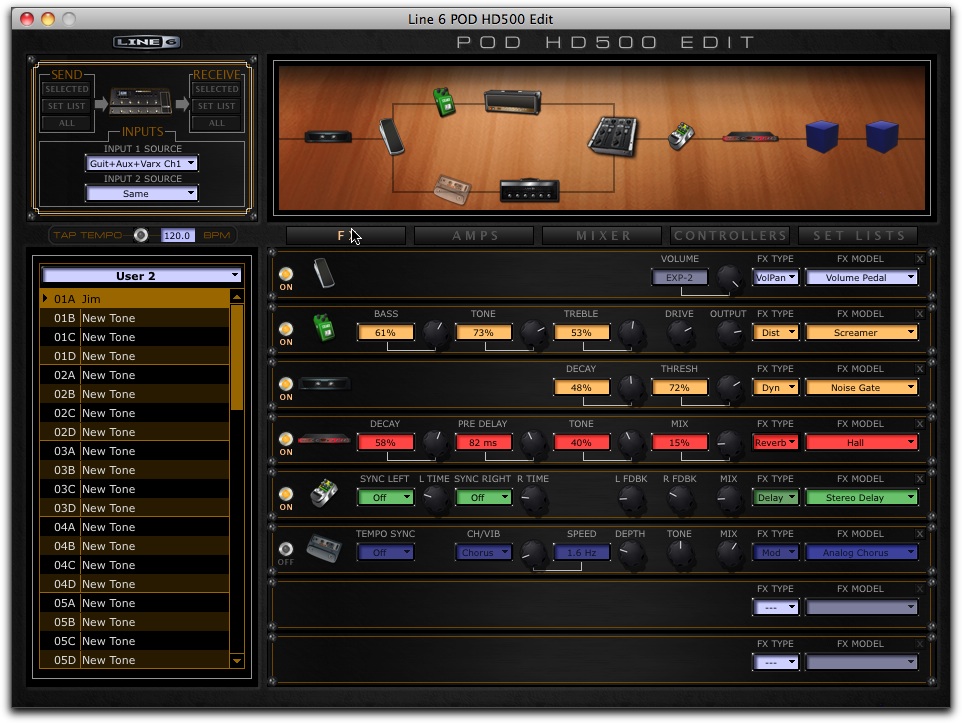
The HD500 gives you complete control over your tone from detailed amp settings to a variety of effects, mics and cabinets that can be added to your tone. Settings can be changed on the fly, using the controls on the device, or from your computer, using the Line 6 software.
Overall, I like the HD500 software, but I didn’t like the effects edit window as much as I like Pod Farm.
In HD500 Edit the effects window is too small for me. I understand that you can edit multiple effects at once, which is great when building a preset, but I’d like to have the option to zoom in close on an effect and work on that separately. Basically, I’d like the effects window to work like the amp window — focused on one thing.
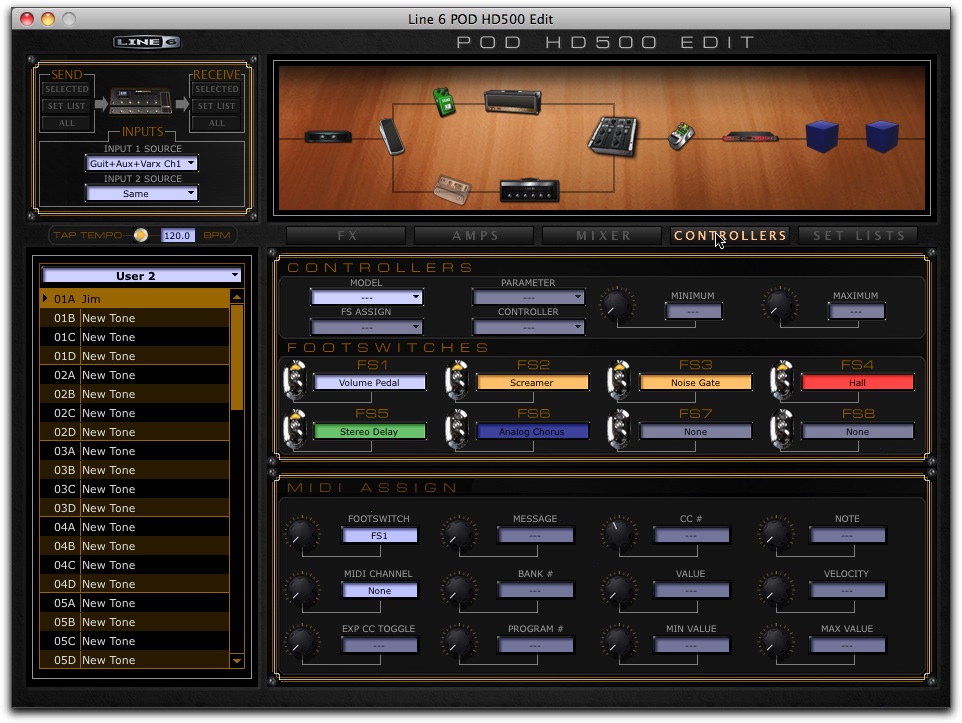
Arranging amps and effects with the HD500 software is really simple. Just drag and drop things where you want them to be — again, you have total control.
New in this version is the ability to put an effect before both amps if you’re making a dual amp tone. I love that feature. Now I can put a Chorus pedal on the entire tone and let it hit both amps when I turn it on. Very smart fix from Line 6.
One miscellaneous item that is rarely mentioned in any review that should be is the tuner. Line 6 makes the best tuners on the market. Yes, most of us can tune by ear, but every once in a while it’s nice to get back to a perfect standard tuning. I hate those tuners that flutter all over the place, so you never know if you got it right on or not. Line 6 nails it every time with their tuner. I appreciate that.
The HD500 also works with the company’s Variax digital guitars and the DT50 amplifiers. I haven’t had a chance to review either of those items, but hopefully one day soon I’ll do those too.
I don’t know what else you would need from a stompbox that Line 6 doesn’t offer. This is the third Line 6 stompbox I’ve had over the years and all three still work perfectly. They’re tough, they sound great, they’re versatile and they’re accurate in tonal characteristics. Well worth the money.