
Wineanorak:
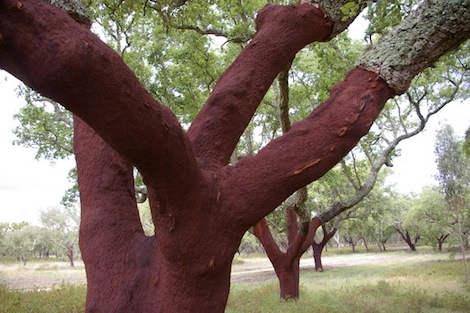
It all starts in the forest. Cork oaks are harvested every nine years, once they reach maturity. It doesn’t harm the tree, and the cork bark regrows. Most cork forests are in Portugal and Spain.
Cork is one of those things you never think about but, when it comes up and you read a story like this, you discover it’s actually kind of fascinating. For example, it never occurred to me that cork was actually tree bark.
«it never occurred to me that cork was actually tree bark»
Living in France, It’s actually one of the first thing we learn in primary school (Cork Boards, Coasters [sous-verre, sous-bock]) and later with beverage bung (Cider, Beer, Champagne, Wine).
Hmm, that’s strange, must be an old-world thing 😛
I’ve always believed that Portuguese cork was the best in the world.
Why?
Because it is! 🙂 It has to do with the favourable climate and the fact that we’ve been perfecting it for centuries.
Some info here: http://www.cork.pt
The failure rate of cork stoppers in wine bottles is dreadful. Corks are susceptible to a chemical compound known as 2,4,6-Trichloroanisole (or TCA for short) which, when used as a stopper in a wine bottle, renders the wine undrinkable. The failure rate due to corks infected with TCA is anything from one in twenty to one in six, depending on who you believe.
This is why we are seeing wines sealed with alternative closures like screwcaps and synthetic corks.
Well that is true in countries where wine is treated like Sodas. But in France, Spain, Italy, Germany, wine Is more regulated than drugs, quarantine procedure or white rooms…
It’s another story when wines (including champagne [which is an assemblage of wines] and Cider to some extent [Label-ised like wines]) are treated like national treasures and not some percentage on a drink-me-to-get-drunk-bottles
No offense… but to have a culture of wine (and therefore the will to get straight-jacket-tight regulation around It) you actually need sun, a lot of It and controllable humidity… (Mediterranean or continental weather or simply closer to the equator, than per say Great-Britain or ireland)
Too much cold or humidity and the culture of the land is limited to macerated-Grain/Fruit[other than grape]/Tuber based alcohols… which are generally stronger and/or more manipulated after the first draft (double distillation, added flavor(s), addition of sugar, etc.)
Cheers
Kinda struggling to see the point you’re making there. Are you suggesting that “quality” wine (from France, Spain, Italy, etc.) isn’t as susceptible to cork taint as others? I’d argue that it needs to be protected from it just as much, and even more than “industrial” wines from wherever.
I know of wine producers in Italy and France who bottle some of their best wines (selling up to and in excess of €100 per bottle) under screwcaps.
Cork as a wine closure is 17th century technology. we need to move on.